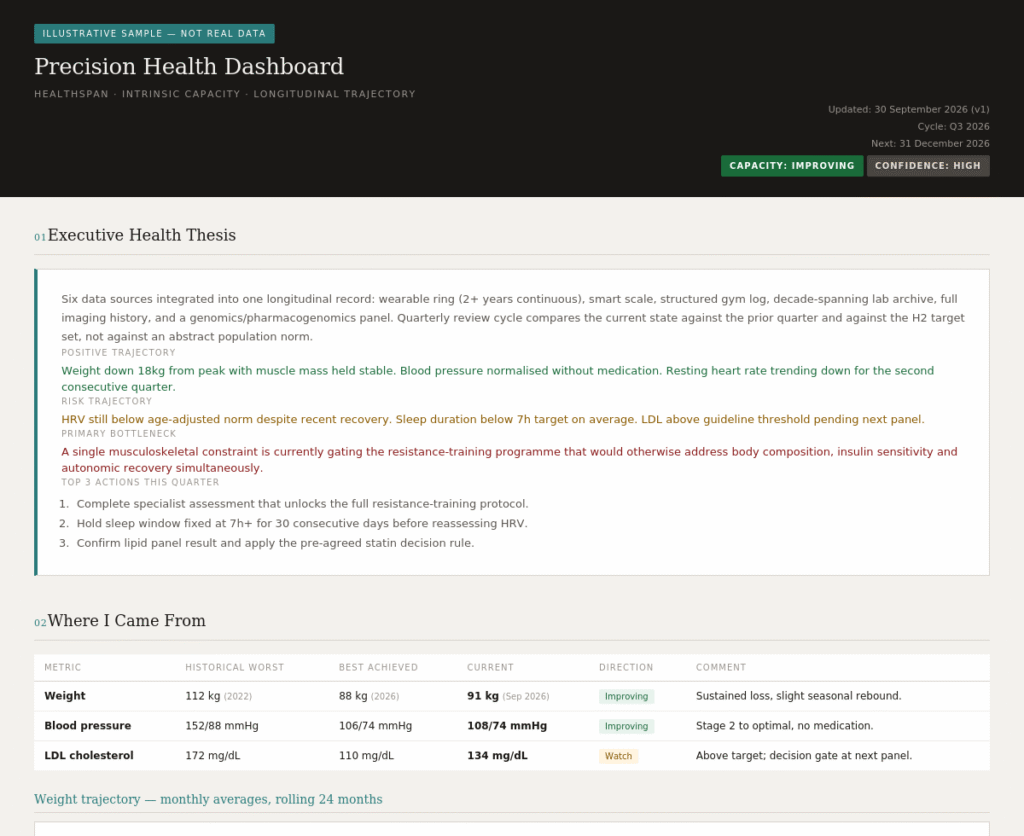
Building the interface took one prompt (really!), but the health record underneath took ten years.
Recently, I reviewed another investment deck for another AI-powered health platform promising to integrate data, optimise health, support longevity, connect users to providers and, somewhere along the way, revolutionise the entire patient experience.
I have seen versions of this deck for years. It reminded me of the classic The Hero with a Thousand Faces, if you are into fiction. As an evaluator of innovation grants and an occasional advisor to investors looking at early-stage health technologies, I know the structure too well. Health data are fragmented; patients cannot see the full picture; clinicians work with incomplete information. The company will therefore build the integration layer, apply artificial intelligence and create a personalised health assistant.
The problem is real, mind you. I have argued for years that clinical laboratories and other health providers should offer better integration to their users. It improves continuity, makes information more useful and, from a business perspective, creates a relationship that is harder to commoditise than another isolated blood test or consultation.
What prompted me to write this, though, is that this latest deck arrived just after I had finished building an AI personal health dashboard of my own.
I spent years imagining the perfect tool, and the other day I decided it was time to start building it. Claude produced the first working interface in one attempt.
That experience left me with an uncomfortable question. If a general-purpose AI can now create a credible personal interface and synthesis layer in minutes, once the data have been assembled, what exactly is the defensible product being offered by the growing number of start-ups whose central proposition is health data integration?
I did not solve institutional interoperability, automate access to hospital systems or reconcile data from multiple providers in real time. I assembled my own record manually over many years, as I’ll explain below. What Claude made dramatically cheaper was, one, the visible consumer layer: organising that record, presenting it coherently and creating a structure through which I could explore it. And two, providing insight over the aggregated data, contextualized with medical knowledge and research.
The old bioinformatics lesson
I began working in bioinformatics around thirty years ago. At the time, people outside the field imagined that we spent our days developing elegant algorithms to unlock the secrets of biology. Occasionally, we did. But most of the work was data formatting, organisation and quality control. By “most”, I would estimate 80% to 90% of the time and effort.
One laboratory called a gene by one identifier, another used a different version, and a third sent a spreadsheet whose most important column had silently become text because someone had opened it in the wrong software. Before any analysis could begin, the data had to be found, understood, cleaned, reconciled and placed into a structure in which comparisons meant something. The code was rarely the hardest part. Knowing what the data represented was.
We now live in the age of foundation models, wearable sensors and consumer genomics. Data formatting has become easier because machines are increasingly good at reading heterogeneous files. Data quality has become more important because the same machines can produce an impressively coherent interpretation of information that should never have been combined, trusted or interpreted in that way.
This is the first lesson my personal dashboard taught me. AI has reduced the technical cost of integration, but it has not reduced the cost of knowing whether the integrated data are believable.
Assembling ten years of myself
My health data were distributed across the usual collection of institutions and devices, but years ago I made a concerted effort to move to digital, automated data capture that is now paying off.
I use a Withings watch, blood pressure monitor and scale, as well as an Oura ring. I moved from recording training sessions in a notebook to using an app that captures exercises, weights and repetitions. These devices generated large time series covering activity, sleep, weight and many other measurements. There was too much sensor data to place indiscriminately into a useful working context, so I had to extract and summarise what could be relevant.
The medical record required a different kind of work. Over the past decade I have mainly used two private hospital networks and, fortunately, often the same clinical pathology provider. I downloaded reports from blood tests, consultations, MRIs, X-rays, ultrasounds and other examinations. I did not upload raw medical images: I used the clinical reports written by the professionals who had interpreted them. I also added the report from my whole-genome sequence, rather than pretending that a raw genomic file becomes clinically meaningful merely because it is available.
Then there was another less obvious source.
I have journalled for years. My preferred tools are paper and fountain pens, which are not yet known for their interoperability. A couple of years ago, I forced myself to move part of that habit into simple Markdown files in Obsidian, within the same environment I use for knowledge management, planning and strategic reflection. Those entries included incidental observations about my health: a week when sleep was difficult, a period when an injury stopped me training, a change in routine, fascinating accounts of intestinal malfunctions or a simple note about my emotional status.
Individually, most of these observations were close to worthless. Together, they began to provide context for the measurements.
This was the dataset: structured laboratory results, interpreted medical reports, genomic findings, summarised sensor time series, training history and fragments of personal narrative. It was incomplete and imperfect. It was also a closer representation of my health trajectory than anything visible within any individual clinical system.
There is an important privacy point here. I made my own choices about what information to place in which system, and I am not recommending that anyone upload a lifetime of medical information to a consumer AI without understanding how that information is stored, processed and governed. Personal health integration creates value precisely because the data are intimate and longitudinal, but those same properties make failure of privacy or control especially consequential.
From files to trajectories
Before writing code, I tried to define what I wanted the system to do. This is another habit left over from old bioinformatics: no code should be written until there is a clear understanding of the question it is expected to answer. I had already explored the conceptual model while writing Precision Diagnostics: A Founder’s Journey. My central concern is personal trajectories. A health system that compares a person with a population reference range sees one kind of truth. A system that compares that person with their own history may see something richer and more informative.
I wanted a simple interface that could organise my information around those trajectories rather than isolated measurements. Where had I come from? What had remained stable? What appeared to be changing? Which signals might deserve attention, and which were more likely to be noise, temporary disruption or differences between measurement systems? Where was I heading and what could I do about it?
At this point, the “experienced” (a.k.a. old) bioinformatician in me began considering languages and frameworks. I had not coded seriously for some time, but Python felt excessive for a first version. I was reading about current web-development tools and feeling the same suspicion towards “vibe coding” that a dinosaur might have felt towards the small mammals running between its feet.
Then Claude just built the interface!
It was not a regulated medical device. It was not a validated diagnostic system. It did not become my physician. It was a personal interface over information I had assembled and a framework for asking better questions.
Still, the first version was far better than I expected. More importantly, when I asked whether the system could be kept current through weekly and monthly reviews, the answer was technically straightforward and could be based on simple “conversations”. The interface was no longer the difficult part.
Making visible the invisible trends
Acute health events were obvious in the record. I did not need artificial intelligence to tell me that I had undergone meniscus surgery or had a tooth implant removed (not the best way to spend a Tuesday afternoon). A dashboard adds little when the event is already dominating one’s attention.
The value appeared elsewhere. Across ten years, slight changes could be placed beside one another. Laboratory measurements could be viewed alongside changes in weight, training, sleep, injuries and medical events. A single variation in a blood parameter might mean little. A direction sustained over several measurements, viewed with changes in other data, creates a better question.
No individual professional had previously seen the same picture. This was not a failure by my doctors. My general practitioner has known me for years, treats me as a partner in managing my health and has my utmost respect. The problem is that the information lived in separate institutional and commercial systems, collected at different frequencies and for different purposes. A physician cannot interpret a history that the system does not place in front of him.
Do not imagine that the dashboard miraculously made a new diagnosis. Instead, it surfaced trends worth discussing with my physician. I could show him a condensed trajectory rather than arrive with a folder of unrelated reports. Discussions with my personal trainer also became more precise. He has helped me navigate the consequences of decades spent training too hard at almost everything I attempted. The combination of injury history, training records and recovery data gives us a better basis for deciding what I should do next.
I do not see my dashboard replacing my interactions with medical or health professionals any time soon, but I see it changing my role in those interactions. I arrive better prepared, with a longer memory and more specific questions. Their expertise becomes more productive because less of the consultation is spent reconstructing fragments of the past.
Longevity, supplements and the evidence filter
I am over fifty, so longevity is no longer an abstract interest.
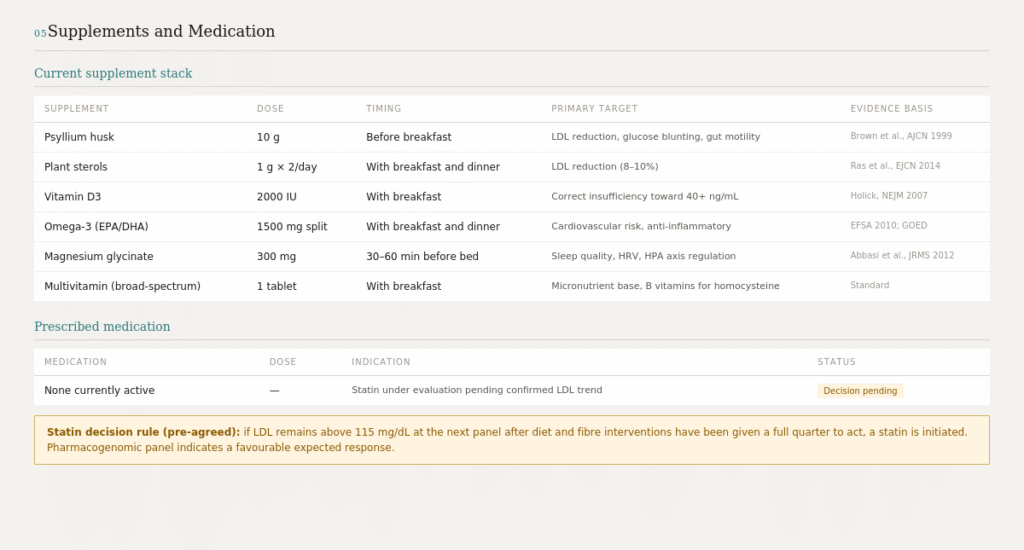
I see people my age around me attend longevity clinics and emerge with programmes involving a remarkable number of daily supplements. Some may be useful; others rest on biological plausibility, small studies, surrogate outcomes or the assumption that “natural” means both effective and harmless.
My dashboard gave me a different starting point. Considering my stated objectives, current status and inferred future trajectory, I could ask whether a proposed supplement, diet or intervention had meaningful support from randomised controlled trials or meta-analyses, and whether the populations studied resembled my circumstances. I could then discuss the result with a professional who understood the medical context.
This does not remove uncertainty. Published evidence may be weak, contradictory or irrelevant to an individual. Consumer AI can misread studies, ignore contraindications and imagine references with great confidence. I still need to inspect important sources and involve the appropriate clinician. But the combination of a longitudinal personal record and an explicit evidence hierarchy is more useful than generic longevity advice assembled from whatever is currently fashionable.
The personalisation does not come from an AI addressing me by name. It comes from connecting the evidence to a history that actually belongs to me.
The vanishing integration premium
This brings me back to the investment decks.
For years, integrating health information was itself a substantial technical proposition. A company could create value by connecting incompatible systems, normalising formats and building an interface through which the user finally saw a coherent record. That layer is becoming dramatically cheaper.
General-purpose AI can read reports, transform tables, summarise time series and generate a working interface. Connectors can keep the information current. None of this is automatically safe, clinically valid or scalable across a health system. But it is increasingly sufficient to reproduce the visible part of many “AI health assistant” demonstrations.
If the demonstration can be recreated with a general model and a simple web page, the demonstration is no longer the moat.
There may still be excellent companies to build here. Their defensibility will have to sit deeper in the system: trusted access to longitudinal data, superior data quality, validated models, regulated clinical claims, integration into professional workflows, privacy-preserving infrastructure, evidence that outcomes improve, or commercial relationships that allow the product to be used and reimbursed. The interface and the “intelligence” may be necessary, but are unlikely to be sufficient.
This changes how I think about early-stage health technology proposals. “We integrate all your health data” is no longer a complete value proposition. I want to know what happens after integration. Which decision becomes better? Has that improvement been validated? Who accepts responsibility when the interpretation is wrong? Why will the user continue to need this company when the next generation of consumer AI can rebuild the visible functionality in an afternoon? Increasingly, a regulatory roadmap is moving to the top of my “must-have” list.
A trend for innovative companies?
A recent Portuguese example illustrates how quickly a health business model can be overtaken when the underlying intervention changes.
Nutribalance, a weight-management company founded in 2010, was declared insolvent in June 2026. In its account of the collapse, the company pointed to the rapid adoption of medicines including Ozempic, Mounjaro, Wegovy and Saxenda as a major change in the market for weight loss. That is the company’s interpretation of its failure, not proof that one technology alone caused the insolvency: businesses rarely fail for a single reason.
A business built around the superiority of behavioural programmes did not merely acquire a new competitor. It encountered a different technical reality. Randomised trials of once-weekly semaglutide and tirzepatide have shown weight reductions that earlier non-surgical interventions struggled to approach. These medicines are not appropriate for everyone, can produce adverse effects and require medical assessment. But their significance here is commercial as much as clinical. They changed what customers could reasonably expect from an obesity intervention.
The lesson for AI health companies is not that every integration start-up will disappear. It is that business models built around a technically difficult function must be reconsidered when that function becomes easy. The company has to own something beyond the difficulty that existed when it was founded.
The dashboard is not the asset
Thirty years after I began dabbling in bioinformatics, and now I find myself in a strangely familiar place.
Data formatting is less painful. Data quality, provenance and interpretation remain difficult. We have better tools for bringing information together, but the meaningful work still begins before the analysis: deciding what to collect, whether it can be compared, what is missing, which source deserves trust and what question the resulting record can legitimately answer.
Perhaps the old bioinformaticians remain useful after all. We learned to think before writing code because computing was expensive and data were badly behaved. Computing is now abundant. The data are still badly behaved.
My personal precision health dashboard has already been valuable. It helps me see my health as a trajectory, prepare better questions and work more productively with the people who support me. I expect it to become more useful as the record grows.
But the dashboard itself was almost trivial to create.
The valuable asset was the decade of information behind it, the effort required to understand that information, and the judgement needed to prevent an attractive synthesis from becoming a false one.
Building the interface took a single prompt, but the record underneath took ten years.
For anyone building or financing the next AI health assistant, that is where I would begin the discussion.
Sources and note
- Rui Neves, “Portuguesa Nutribalance faliu. Culpa o Ozempic”, Jornal de Negócios, 18 June 2026.
- Wilding et al., “Once-Weekly Semaglutide in Adults with Overweight or Obesity”, New England Journal of Medicine, 2021.
- Jastreboff et al., “Tirzepatide Once Weekly for the Treatment of Obesity”, New England Journal of Medicine, 2022.
This is a personal reflection on data integration and health technology, not medical advice. Personal medical data should be handled with appropriate attention to privacy, security and professional interpretation.